
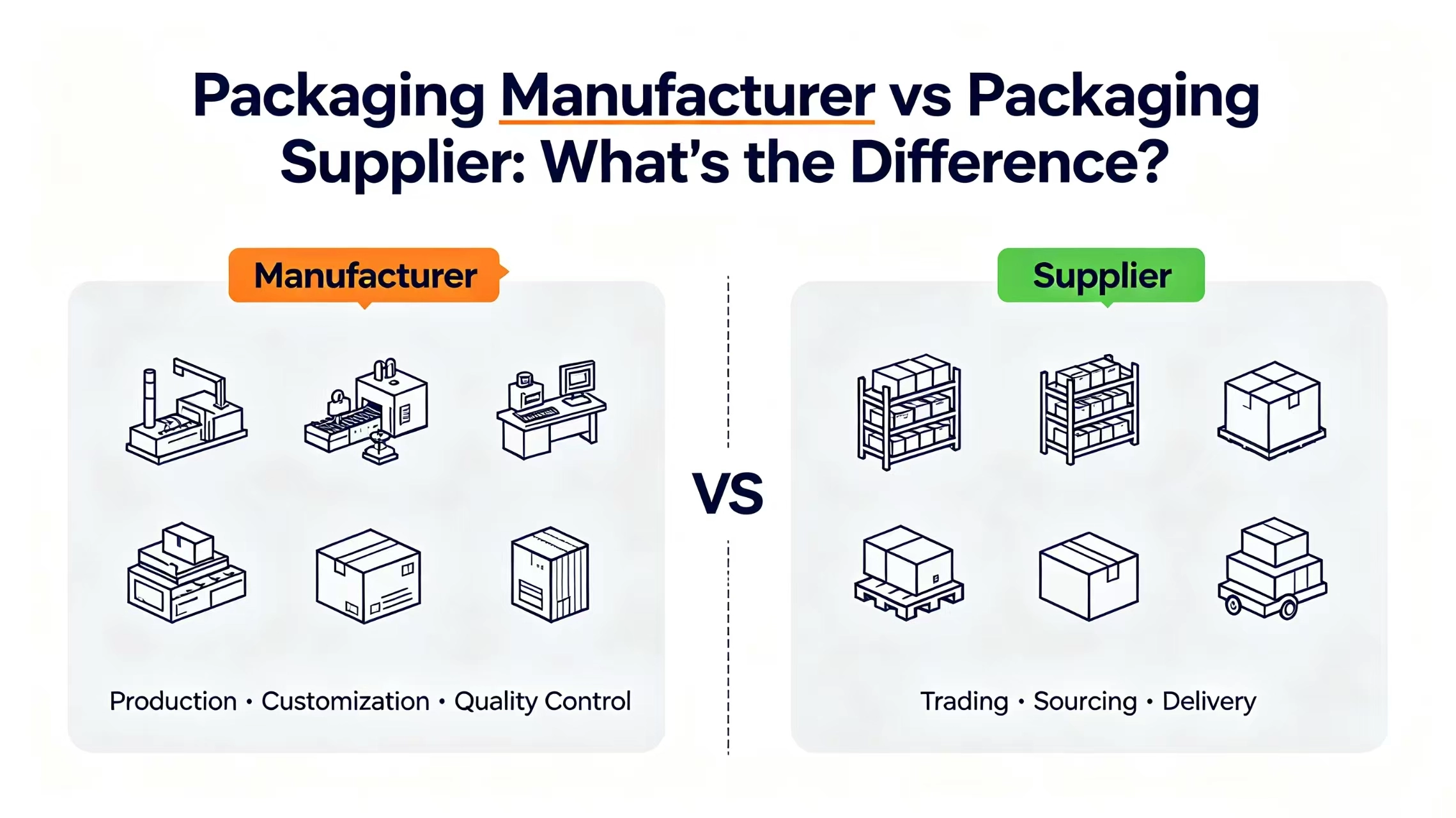

Packaging Manufacturer vs Packaging Supplier: What's the Difference?
- Packaging Manufacturer vs Packaging Supplier: What's the Difference?
- Quick Answer: Manufacturer vs. Supplier
- What Is a Packaging Manufacturer?
- What Is a Packaging Supplier?
- Packaging Manufacturer vs. Packaging Supplier: Key Differences
- 1. Production Control
- 2. Customization Capabilities
- 3. Prototyping and Sampling
- 4. Quality Control
- 5. Communication
- Is a Packaging Manufacturer Always Better Than a Packaging Supplier?
- What Should You Ask a Packaging Company?
- 1. Do you own or operate your manufacturing facilities?
- 2. Which production processes are handled in-house?
- 3. Where will my packaging be manufactured?
- 4. Can I receive a prototype before mass production?
- 5. Who manages quality control?
- 6. Can you provide examples of similar projects?
- 7. Can you support structural design?
- 8. What happens if there is a production problem?
- Manufacturer vs. Supplier: Which One Should You Choose?
- How to Verify Whether a Packaging Company Is a Manufacturer
- Factory Information
- Product Information
- Sample Development
- Production Communication
- Case Studies
- How Yifeng Packaging Fits Into the Manufacturing Model
- When Should You Work Directly With a Packaging Manufacturer?
- New Product Launches
- Premium Packaging
- Large Production Runs
- Complex Packaging Structures
- Long-Term Packaging Programs
- Final Takeaway
- Looking for a Custom Packaging Manufacturer?
- FAQ
Packaging Manufacturer vs Packaging Supplier: What's the Difference?
When sourcing custom packaging, buyers often encounter the terms packaging manufacturer, packaging supplier, packaging factory, and packaging company. These terms are sometimes used interchangeably, but they can describe different business models and levels of manufacturing involvement.
The main difference is that a packaging manufacturer directly produces packaging or controls the manufacturing process, while a packaging supplier is a broader term that can refer to a company that supplies packaging products, either through its own production facilities or through manufacturing partners.
For brands purchasing custom packaging, understanding this difference can help clarify production responsibility, communication, quality control, customization, and project management.
Quick Answer: Manufacturer vs. Supplier
A packaging manufacturer typically operates its own production facilities or directly manages manufacturing processes.
A packaging supplier may manufacture packaging itself, source packaging from third-party factories, or coordinate production through multiple manufacturing partners.
Neither business model automatically guarantees better quality or service. The important question is who is responsible for the actual production and quality control of your packaging.
| Factor | Packaging Manufacturer | Packaging Supplier |
|---|---|---|
| Own production facilities | Usually | May or may not |
| Manufacturing control | Direct | Depends on business model |
| Structural design support | Often available | Depends on supplier |
| Material sourcing | Direct or controlled | May involve third parties |
| Prototyping | Often available | Depends on supplier |
| Printing & finishing | Usually controlled directly | May be outsourced |
| Quality control | Direct manufacturing QC | May be managed through partners |
| Customization | Usually extensive | Depends on manufacturing partner |
| OEM / ODM | Common | Depends on capabilities |
| Communication | Often directly with production team | May involve sourcing or project team |
The distinction is useful, but buyers should evaluate the actual capabilities of each company rather than relying only on the title "manufacturer" or "supplier."
What Is a Packaging Manufacturer?
A packaging manufacturer is a company that produces packaging products through its own manufacturing facilities or directly controls the manufacturing processes.
For custom packaging, a manufacturer may be involved in several stages of the project:
-
Structural design
-
Material selection
-
Prototyping
-
Printing
-
Finishing
-
Die cutting or forming
-
Assembly
-
Quality control
-
Packing
-
Mass production
For example, a custom packaging manufacturer may produce rigid boxes, folding cartons, corrugated boxes, paper tubes, gift boxes, cosmetic packaging, jewelry boxes, and other customized paper packaging.
The manufacturer may work directly with the brand, designer, importer, distributor, or purchasing team to develop the packaging according to specific technical requirements.
What Is a Packaging Supplier?
"Packaging supplier" is a broader term.
A packaging supplier may be:
-
A packaging manufacturer
-
A distributor
-
A sourcing company
-
A trading company
-
A company working with multiple manufacturing partners
-
A company that combines manufacturing and sourcing capabilities
Therefore, simply being described as a "packaging supplier" does not tell you whether the company owns a factory.
A supplier may be useful when a buyer needs multiple packaging products from different sources or wants one company to coordinate several parts of the supply chain.
However, for highly customized packaging, it is important to understand who actually manufactures the product.
Packaging Manufacturer vs. Packaging Supplier: Key Differences
1. Production Control
The most important difference is often production control.
A manufacturer has direct involvement in production and can generally communicate directly with the teams responsible for manufacturing.
A supplier that outsources production may need to coordinate specifications, schedules, quality issues, and changes with another factory.
This can affect the speed of technical communication and problem resolution.
However, the actual level of control varies from company to company.
2. Customization Capabilities
Custom packaging often requires more than changing the logo.
A project may involve:
-
Custom dimensions
-
Custom box structures
-
Special materials
-
Custom inserts
-
Custom closures
-
Printing
-
Foil stamping
-
Embossing
-
UV finishing
-
Lamination
-
Special assembly requirements
A manufacturer with structural and production capabilities can often work directly with the customer to adjust the design according to manufacturing requirements.
For highly customized projects, buyers should ask whether the company has its own engineering, production, and quality-control capabilities.
3. Prototyping and Sampling
Physical prototypes are important for custom packaging because a digital design does not always reveal manufacturing or structural issues.
A packaging manufacturer may provide prototype development before mass production.
The prototype can be used to check:
-
Product fit
-
Box dimensions
-
Structural strength
-
Closure performance
-
Insert positioning
-
Printing
-
Color
-
Finishing
-
Overall appearance
A supplier can also provide samples, but buyers should clarify whether the samples are produced in the final production facility or sourced elsewhere.
4. Quality Control
Quality control can be managed differently depending on the business model.
A manufacturer may control quality throughout the production process, including:
-
Incoming materials
-
Printing
-
Die cutting
-
Gluing
-
Finishing
-
Assembly
-
Final inspection
-
Packing
A supplier that uses third-party factories may rely on the manufacturing partner's quality-control procedures or conduct separate inspections.
For large or highly customized orders, buyers should ask:
Who performs the quality inspection, and where does the inspection take place?
5. Communication
Custom packaging involves technical decisions.
For example, changing the paper thickness may affect:
-
Box dimensions
-
Folding
-
Strength
-
Cost
-
Printing
-
Assembly
Changing an insert can also affect the internal structure of the box.
When working directly with a manufacturer, technical questions can often be communicated directly to the production or engineering team.
With a sourcing-based supplier, communication may pass through several parties.
Neither model is automatically better, but the communication process should be clear before production begins.
Is a Packaging Manufacturer Always Better Than a Packaging Supplier?
Not necessarily.
The appropriate option depends on the requirements of the project.
A packaging manufacturer may be suitable when you need:
-
Highly customized packaging
-
Structural design support
-
Prototyping
-
Large production volumes
-
Consistent specifications
-
Direct manufacturing communication
-
Complex printing and finishing
-
Long-term packaging development
A packaging supplier may be suitable when you need:
-
Multiple packaging categories
-
Packaging from different production sources
-
Sourcing coordination
-
A broader range of products
-
Supply-chain management
The key point is that the label itself is less important than the actual capabilities and responsibilities of the company.
What Should You Ask a Packaging Company?
Before placing a custom packaging order, buyers can ask the following questions.
1. Do you own or operate your manufacturing facilities?
This helps clarify whether the company manufactures directly or works primarily through third-party factories.
2. Which production processes are handled in-house?
Ask about printing, die cutting, forming, gluing, finishing, assembly, and other relevant processes.
3. Where will my packaging be manufactured?
The answer can help you understand the production location and supply-chain structure.
4. Can I receive a prototype before mass production?
Confirm whether prototypes are available and whether they represent the actual production structure and materials.
5. Who manages quality control?
Ask whether quality inspection is performed by the manufacturer, supplier, a third-party inspection company, or a combination of these.
6. Can you provide examples of similar projects?
Ask for examples involving similar materials, structures, product categories, finishing techniques, or production quantities.
7. Can you support structural design?
If you only have a product and packaging concept, structural design support can be important.
8. What happens if there is a production problem?
Clarify who is responsible for correcting defects, replacing products, adjusting specifications, or resolving production delays.
Manufacturer vs. Supplier: Which One Should You Choose?
Instead of choosing based only on the words "manufacturer" or "supplier," evaluate the company according to your actual packaging requirements.
For example:
| Your Requirement | Important Capability |
|---|---|
| Simple stock packaging | Product availability |
| Custom logo printing | Printing capability |
| Custom box structure | Structural design |
| Premium rigid packaging | Rigid-box manufacturing |
| Complex inserts | Structural engineering and assembly |
| Large-volume production | Manufacturing capacity |
| Multiple finishing effects | Printing and finishing |
| International packaging project | Production + logistics coordination |
| New packaging development | Prototyping and technical support |
For a complex custom packaging project, direct manufacturing capabilities can be particularly useful because structural design, materials, production, and quality control are closely connected.
How to Verify Whether a Packaging Company Is a Manufacturer
Buyers can look for several types of evidence.
Factory Information
Look for:
-
Manufacturing facility information
-
Production-line photographs
-
Factory videos
-
Machinery information
-
Production capacity
-
Manufacturing locations
Product Information
A manufacturer should be able to explain:
-
Materials
-
Structures
-
Production processes
-
Finishing methods
-
Quality-control procedures
Sample Development
Ask whether the company can develop prototypes according to your specifications.
Production Communication
Ask whether technical questions can be answered by people involved in production or engineering.
Case Studies
Look for projects involving similar products, materials, structures, and production requirements.
How Yifeng Packaging Fits Into the Manufacturing Model
Yifeng Packaging provides custom packaging manufacturing services for brands and businesses that require customized paper packaging.
Its capabilities include structural design, material selection, prototyping, printing, finishing, quality control, and mass production.
The company produces packaging such as:
-
Rigid boxes
-
Folding cartons
-
Corrugated boxes
-
Paper tubes
-
Gift boxes
-
Jewelry boxes
-
Cosmetic packaging
-
Hair and wig packaging
-
Apparel packaging
-
Custom inserts
Yifeng also states that it provides more than 100 material options and more than 30 finishing options for custom packaging projects.
For buyers evaluating a packaging manufacturer, these capabilities can be relevant when a project requires multiple production processes rather than simple stock packaging.
When Should You Work Directly With a Packaging Manufacturer?
Working directly with a manufacturer can be useful when packaging requires significant customization.
This can include:
New Product Launches
New products often require packaging to be developed around exact product dimensions and presentation requirements.
Premium Packaging
Luxury packaging may involve rigid structures, specialty papers, inserts, foil stamping, embossing, and other finishing processes.
Large Production Runs
Large orders require consistent specifications and production control.
Complex Packaging Structures
Custom magnetic boxes, drawer boxes, multi-piece packaging, and customized inserts may require closer coordination between design and manufacturing.
Long-Term Packaging Programs
Brands with recurring orders may benefit from establishing standardized specifications and quality requirements directly with a manufacturing partner.
Final Takeaway
The difference between a packaging manufacturer and a packaging supplier is primarily related to manufacturing ownership, production control, and supply-chain responsibility.
A manufacturer generally has direct involvement in production, while a supplier may manufacture packaging itself or coordinate production through other companies.
For buyers, the most useful questions are not simply:
"Are you a manufacturer?"
but:
"Where is my packaging produced?"
"Which processes are handled directly?"
"Who controls quality?"
"Can you develop prototypes?"
"Who is responsible for solving production problems?"
Understanding these details makes it easier to evaluate packaging companies based on the actual requirements of your project.
Looking for a Custom Packaging Manufacturer?
Yifeng Packaging provides customized paper packaging solutions, including rigid boxes, folding cartons, corrugated boxes, paper tubes, gift boxes, cosmetic packaging, jewelry packaging, hair and wig packaging, and other customized packaging products.
Tell us about your product and packaging requirements to discuss your project with our team.
Request a Custom Packaging Quote →
FAQ
Is a packaging manufacturer the same as a packaging supplier?
Not always. A manufacturer produces packaging directly or controls manufacturing operations, while "supplier" is a broader term that can include manufacturers, distributors, sourcing companies, and trading companies.
Is it cheaper to buy directly from a packaging manufacturer?
Not necessarily. Pricing depends on materials, production volume, packaging structure, customization, finishing, logistics, and other project requirements. Direct manufacturing may reduce some intermediary costs, but the total project cost should be evaluated based on the complete specification.
Can a packaging supplier also be a manufacturer?
Yes. A company can both manufacture packaging and source or distribute additional packaging products.
How can I tell if a packaging company is a real manufacturer?
Ask about its manufacturing facilities, production processes, machinery, quality-control procedures, production locations, prototypes, and case studies. Buyers can also request relevant factory or production information.
Should I choose a manufacturer or a supplier for custom boxes?
The decision depends on the project. For highly customized boxes, buyers may place greater importance on structural design, prototyping, manufacturing control, and quality management. For broader sourcing requirements, a supplier with multiple manufacturing partners may also be appropriate.
Can a manufacturer handle OEM and ODM packaging?
Many custom packaging manufacturers offer OEM and ODM services. Buyers should confirm which design, engineering, sampling, production, and customization services are included.
What is the difference between a packaging factory and a packaging manufacturer?
The terms are often used similarly. "Packaging factory" usually emphasizes the physical production facility, while "packaging manufacturer" emphasizes the company's role in producing packaging products.
You May Also Like

Wholesale Custom Foldable Wig Box Packaging
-
-
-
-
-
🎀 Premium foldable rigid box tailored for wig brands, hair extensions, and salon packaging.
-
🎁 Space-saving flat-pack structure paired with smooth magnetic closure and elegant interior.
-
👩 Keeps wigs in good shape, suitable for retail display, shipping, and high-end hair product gifting.
-
-
-
-

Wholesale Luxury Custom Magnetic Perfume Gift Boxes
-
-
-
-
🎀 Exquisite high-end rigid magnetic boxes specially customized for premium fragrance and cosmetic brands.
-
🎁 Premium rigid cardboard paired with smooth magnetic closure for a luxurious unboxing experience.
-
👧 Perfect for designer perfumes and limited-edition scent sets to enhance brand grade and leave deep impressions.
-
-
-
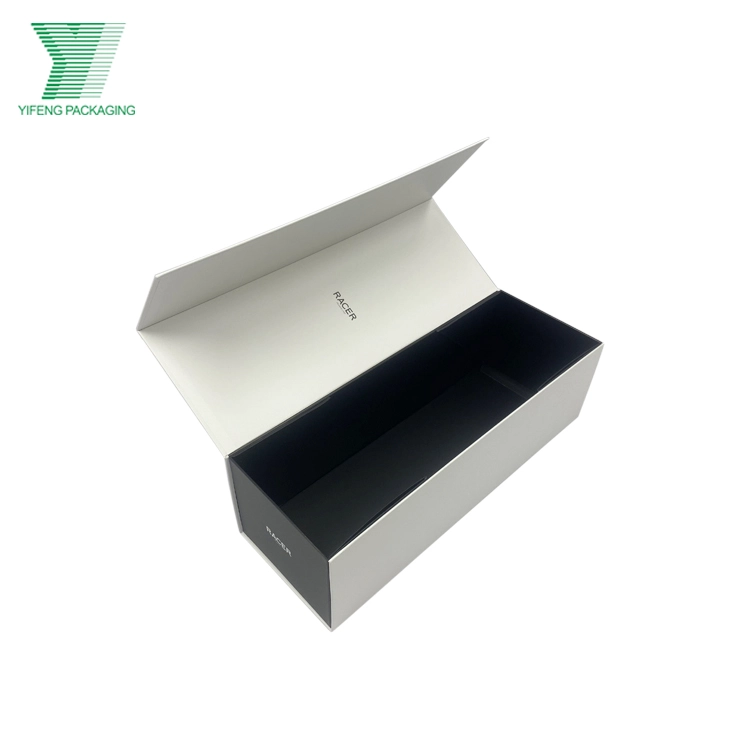
Custom Collapsible Magnetic Rigid Gift Box, Long Folding Packaging Box For Heating Gloves
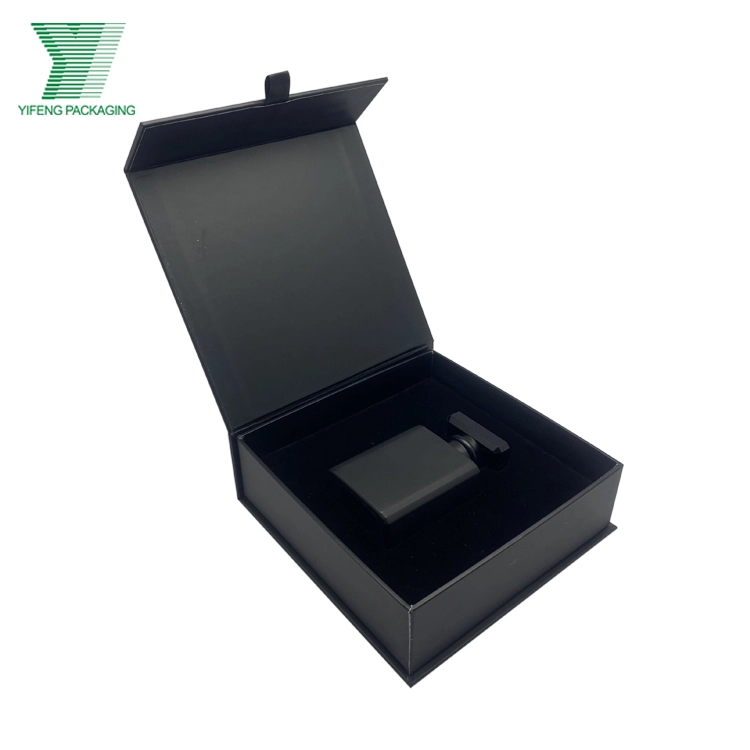
Custom Luxury Black Magnetic Flip Perfume Gift Box For Men Cologne Packaging
Want Similar Packaging for Your Brand?
If you have any comments or good suggestions, please leave us a message, later our professional staff will contact you as soon as possible.
Contact
Email: marketing@yfpackaging.com
Telephone: +86 020 3435 4688
Phone: +86 17818581665
Address: Room 1910, Zhongguang Building, No. 100, Middle of Jiangnan
Avenue, Haizhu District, Guangzhou City, Guangdong Province, China


Instagram
Youtube
TikTok